How had things changed? Why did they change?
If a beat reporter had come to John Thompson with such questions, Thompson could have shut him down outright, or tacitly threatened a loss of team access if he pursued it. The Post assigned a veteran to the story, and as a result, the story hit even harder as a result.
Bill Brubaker was a well respected writer and reporter at the Washington Post over his 23 years at the newspaper from 1985 to 2008. An investigative reporter with previous service at the New York Daily News and Sports Illustrated, Brubaker was well suited to detailed coverage on major sports issues. His 1987 series "Maryland Athletics: Crisis In College Park" received a number of awards by the Newspaper Guild of Greater Washington; a 1990 series on the state of boxing was nominated for a Pulitzer Prize.
A Change In Philosophy
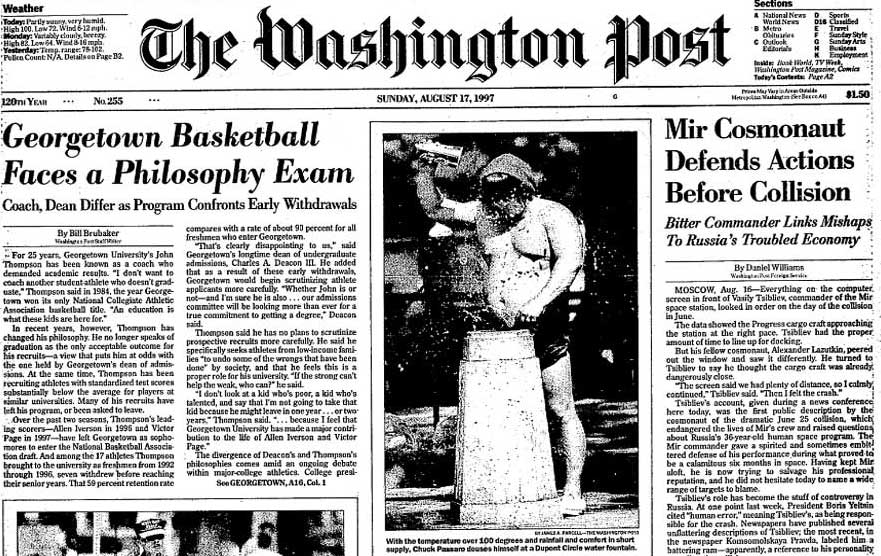
On the morning of August 17, 1997, the Georgetown University men's basketball program was the lead story of the Sunday edition of the Washington Post. It wasn't a game recap or a celebration of some academic honor, and not a story the University enjoyed seeing in the upper left corner of a newspaper landing on more than a million doorsteps across the region. It began as follows:
"For 25 years, Georgetown University's John Thompson has been known as a coach who demanded academic results. "I don't want to coach another student-athlete who doesn't graduate," Thompson said in 1984, the year Georgetown won its only National Collegiate Athletic Association basketball title. "An education is what these kids are here for."It was a story that was, in some ways, years in the making.
"In recent years, however, Thompson has changed his philosophy. He no longer speaks of graduation as the only acceptable outcome for his recruits -- a view that puts him at odds with the one held by Georgetown's dean of admissions. At the same time, Thompson has been recruiting athletes with standardized test scores substantially below the average for players at similar universities. Many of his recruits have left his program, or been asked to leave."
The topic was one of Washington's worst-kept sports secrets, but one rarely if ever discussed within the pages of the Post. The Hoyas' program under John Thompson had been built on the concept of the four year player, the mostly local athletes who committed to a four year education as a foundation for the life ahead of them. The deflated basketball on Thompson's desk, a visible symbol of preparing for the day when the basketball stops bouncing, was as much a part of the Georgetown brand as the gray jerseys and Thompson's game-soaked towel.
Georgetown University took great pride in reminding friend and foe like that its most prominent stars-- Eric Floyd, Patrick Ewing, Reggie Williams, Dikembe Mutombo, Alonzo Mourning-- all earned their college degree before earning millions in the NBA. By 1997, this was no longer the case, and not just among draft picks. The four year players, from the likes of Merlin Wilson and Jonathan Smith to Dwayne Bryant and Mark Tillmon, had given way to new names, of which Allen Iverson and Victor Page were at the forefront. In the years leading up to their departures, however, they were not alone.
"Coach John Thompson of Georgetown University is the rare two-dimensional teacher. He shaped his strategies for victory--the men's NCAA basketball title--by first forming his players as young men to be educated. They would be students first, then athletes."--Colman McCarthy, The Washington Post, 1984
The growth of the Georgetown men's basketball program in this era was unmistakably chronicled within the daily pages of the Washington Post. Once a fourth place finisher in a five newspaper town, the Post became the dominant voice of all things Washington. Even in the days before Ben Bradlee and "All The President's Men", sports was the Post's go-to section, even if such coverage rarely made its way to its front page alongside Congressional hearings or a scoop from the Pentagon.
Today's Post, of course, is in a much different place. Circulation is down to its lowest levels since the 1940s. The newspaper lost $125 million in 2025 and is on pace to meet that in 2026, even after laying off a third of its staff and closing the sports desk. Democracy may die in darkness, but to publisher Jeff Bezos, anticipatory obedience is the path forward.
"We're not a paper of record," said Post executive editor Matt Murray in February 2026.
Three decades ago, the Post was a newspaper of record, and riding a crest of success: average daily circulation of 793,000 and 1,108,000 on Sundays. It owned six major market TV stations, 25 community weeklies, Newsweek magazine, a cable TV company, the Stanley Kaplan educational testing group, and a half-dozen ancillary companies. Newspaper revenue accounted for 39 percent of its $415 million in annual operating income. Investigative journalism was considered a hallmark of its newsroom depth.
So it was on Sunday, August 17, 1997, a day where the issue numbers a whopping 1,547 pages in the Post archives, including Parade Magazine, a hefty television supplement, classified ads, stock market tables, and department store advertising, there was Georgetown University at the top of page A1.
In a pair of articles in 1987, Brubaker introduced Post readers to a high school center named Alonzo Mourning and closely followed his recruiting, reporting that Mourning first met John Thompson while at Sonny Vaccaro's summer camp in Las Vegas. Three years later, a series of interviews formed the basis of a feature titled "John Thompson: Wealth of Control Worthier Than Nugget of Gold", detailing Thompson's process weighing a reported $8 million offer to become general manager of the NBA's Denver Nuggets.
"I was grateful that John Thompson and the dean of undergraduate admissions, Charles Deacon, agreed to be interviewed, separately, about the issues that I raised in the story," Brubaker said this past month.
"I also appreciated their candor. The interviews were done on campus after many weeks of reporting."
Beginning in the 1984-85 season, a note in the Georgetown basketball media guides pointed out that all but two players who had played four seasons under John Thompson had graduated. One player, Craig Shelton (1976-1980), did not complete his degree in four years, the other is a story all its own. The four-year caveat was reflective that not everyone made it through the program. Mike Stokes, one of John Thompson's first recruits, left the team after three semesters. Alonzo ("Cheese") Holloway, Gary Wilson, and Ray Knight all transferred in Thompson's first decade as coach, but these were exceptions in a decade where 30 of John Thompson's first 35 roster recruits earned their degrees within four years.
The overall numbers slipped a bit in the 1980s: while every four year player earned his degree, just 63 percent of incoming recruits from made it that far: some for academics, some for competitive opportunities elsewhere, and some for disagreements with Thompson. By the 1990s, turnover was becoming much more common. The entire recruiting class of 1989-90 -- David Edwards, Mike Sabol, Antoine Stoudamire, and All-Met forward Michael Venson (aka Michael Tate)-- left within three semesters. A press release in 1992 announced that Charles Harrison, the team's second leading scorer, "has decided that attending a junior college would permit him to step away from basketball and enable him to strengthen his GPA," but he actually transferred to Wake Forest, leaving his father, Charles Harrison Sr. to tell the Post that "he didn't have academic problems, or else he wouldn't be at Wake Forest, would he?"
In 1994, two of the three man class that arrived in the fall of 1992 both left the program. In May, center Duane Spencer was reported to be leaving school to to support his family; instead, he enrolled to play at LSU a week later. Two months later, guard Eric Micoud was reported to be taking a leave of absence to perform military obligations in France and would return within a year, but Micoud went to a pro team in France and never returned to Washington.
In 1997, three players left the Hoyas after the season: freshman Shamel Jones, junior Jerry Nichols, and sophomore Victor Page, its leading scorer and an honorable mention All-America selection. Brubaker met Thompson to discuss it further.
For a man not always known for candor, John Thompson held little back in the interviews which formed the basis for the Sunday morning story. Perhaps he just wanted to get a few things off his chest, and he did.
"I don't look at a kid who's poor, a kid who's talented, and say that I'm not going to take that kid because he might leave in one year...or two years," Thompson told the Post. "I feel that Georgetown University has made a major contribution to the life of Allen Iverson and Victor Page."
The article's impact, now decades later, was more than about John Thompson.
Upon his scheduled retirement on June 30, 2028, Charles A. Deacon III (C'64, G'69) will have devoted a remarkable 68 years of his life to Georgetown University, from arriving as a freshman in the fall of 1960 to a staff position in the Department of Admissions and to a 54 year tenure as its director and dean. Deacon also holds a place in Georgetown's basketball history: he was a member of the search committee that hired John Thompson in 1972. Over the decades, Deacon attended nearly every home game at McDonough Gym, Capital Centre, and later Capital One Arena, not because he had to, but because he wanted to. Basketball had elevated the national awareness of Georgetown and he understood the synergy between the two.
The file on every Thompson recruit went through Deacon's office for a formal offer of admission, and the two offices built a compact that formed the intellectual underpinning of the Georgetown basketball philosophy: even if a recruit had lower grades and test scores, a student's commitment to graduating in four years was paramount. The fabric of that compact was tested when Iverson left Georgetown and was torn with the departure of Page.
"Among the 17 athletes Thompson brought to the university as freshmen from 1992 through 1996, seven withdrew before reaching their senior years," Brubaker wrote. "That 59 percent retention rate compares with a rate of about 90 percent for all freshmen who enter Georgetown."
"That's clearly disappointing to us," said Deacon. "Whether John is or not, and I'm sure he is also...our admissions committee will be looking more than ever for a true commitment to getting a degree."
The next paragraph formed a visible contrast.
"Thompson said he has no plans to scrutinize prospective recruits more carefully. He said he specifically seeks athletes from low-income families "to undo some of the wrongs that have been done" by society, and that he feels this is a proper role for his university."
The interviews with Thompson and Deacon took place a few months after Victor Page left school for an ill-fated run at the NBA draft. The 18 months of Page's life spent at Georgetown may have been among the best he ever had. Years before the loss of his right eye from a drive-by shooting, numerous scrapes with the law, and a domestic assault charge which sent him to prison for 20 years, Page was seeking to follow in the footsteps of his former teammate and the 1997 NBA Rookie of the Year, Allen Iverson. Where the Georgetown media guide listed Page as a sophomore from McKinley Tech HS, the Post told a deeper story.
"Page lived with his grandmother in a high-crime, low-income neighborhood of Southeast Washington," it reads. "Both of his parents died of circumstances he declined to discuss. He said he was convicted of stealing a car as a juvenile -- a crime he said he did not commit. He attended two Washington-area public high schools in a four-year period -- Oxon Hill and McKinley Tech -- but did not graduate."
A public records search brought to print what had already been known on the streets, but not in a newspaper of record. It continued:
Following the season, Page was sentenced to 90 days and ordered to a halfway house. At its conclusion, he enrolled in the first of two out-of-town prep schools to meet NCAA eligibility requirements. After receiving his high school diploma at Redemption Christian Academy in Troy, NY, Page received an athletic scholarship from Georgetown University. According to the Post, neither the admissions committee nor Thompson knew that Page had a criminal record.
"In November 1993, shortly before the start of his senior basketball season at McKinley, Page was arrested after D.C. police found a loaded, unregistered, .380 caliber, semiautomatic weapon and sealable bags containing crack cocaine inside a car in which he was riding. Page was charged with cocaine possession, possession of cocaine with intent to distribute, carrying an unregistered firearm and four other gun-related offenses."
"I think that's all we are trying to do here, is to provide an opportunity for the kids that we have here to be successful," Thompson said in an earlier Post article on Page's adjustment as a freshman. "Victor seems to be putting forth the effort, he seems to be working at it. If he's successful, he'll stay here. If he's not, he won't. That's no different than anybody else who's here."
John Thompson's discussion was more than just Page, and the coach openly spoke of his frustration with getting students admitted at-large.
Thompson told Brubaker said there were rules in place that prevented what he called "thousands of black kids" from attending Georgetown University. When asked to elaborate, "[he] leaned forward from his desk and added 'I'm not going to tell you that. If you're too stupid to figure that out, then I don't need to tell you.'" (Thompson clarified himself in the interview that he was not advocating for open admissions.)
The growing tide of turnover in the program was an issue. According to records obtained by Brubaker and the Post, the graduation rate for Georgetown basketball players entering the University from 1987 through 1990 was just 47 percent, compared to 91 percent for the University at large. It also disclosed that players entering from 1993 through 1996 had an average SAT score of 821, compared with an average of 944 for basketball players at other NCAA private institutions and 1275 for all Georgetown students during those same years.
"I'm not going to be afraid of trying to give 50 a chance and only 20 of them survive," Thompson said. "I'm more concerned with trying to find that 20."
John Thompson was no fool: he knew the impact of the Post audience and recognized Bill Brubaker for the journalist he was. Perhaps Thompson was trying to build a larger discussion around college admissions and inner-city youth, or, at the very least, to express frustration with the state of affairs that was NCAA basketball in the late 1990s. In the wake of Page's departure, however, it proved a difficult discussion and one that was not fully addressed over the final 18 months of Thompson's coaching tenure.
Four days after the story was originally published, the Post reported reported that Georgetown's leading returning guard, sophomore Ed Sheffey, had been arrested during an overnight traffic stop in Landover, MD. He was suspended from the team and transferred to a junior college at the end of the fall semester.
In February, 1998, starting freshman Kenny Brunner quit the team mid-season and promptly accepted a scholarship at Fresno State.
The leading scorer from the 1997-98 season, sophomore Shernard Long, was declared academically ineligible for the fall 1998 semester and later transferred to Georgia State. Long became the 15th Georgetown player to transfer from the program since 1990.
These were not the kind of stories which served Georgetown basketball well. In many ways, these were the kind of stories that readers of the Washington Post were used to seeing from places like Maryland and Ohio State and everywhere in between, the kind of stories where the reputation of the Thompson program was a cut above the others. As the 1990s drew to a close, these stories were a reflection on the changes in college basketball, and within Georgetown as well.