A Single Step
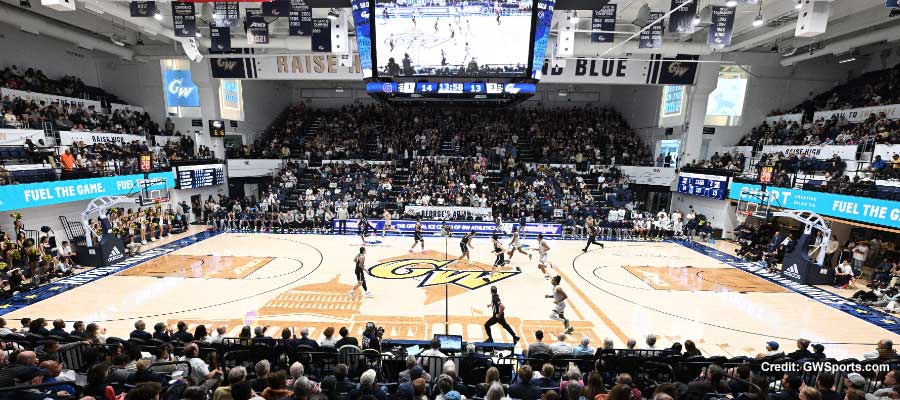
For the first time in nearly 45 years, a Georgetown men's basketball team made the 1.9 mile trip to the corner of 22nd and F Street for a game against George Washington University.
Only a handful of Division I programs are as close geographically: Drexel and Penn, for one, Boston University and Northeastern, another. Excepting engineering, the two universities provide almost the same programs as the other: the humanities, international affairs, business, nursing, law, medicine, and public policy, among others, and its alumni have been part of the lifeblood of the federal city for nearly two centuries. Yet, the two schools remain distant in ways far beyond mere geography.
The exhibition brought together the two largest universities in Washington together for a game that was actively resisted by both teams over the years. How, and exactly why this is, remains a story that is uniquely Washington.
For its first 20 years of operation, Georgetown College was the only institution of higher education in the Nation's Capital, and the only such college between Philadelphia and Williamsburg. Its total enrollment, including the preparatory school, numbered 44. Twelve Jesuits in 20 years had rotated through as its titular president, though supreme authority remained with the Jesuit provincial, often one and the same as the president.
In 1821, Georgetown was joined by two new local institutions: Washington Seminary, which later reformed as Gonzaga College High School, and Columbian College, founded by Baptist missionaries from Philadelphia. A small school by contemporary standards, Columbian arrived with high hopes, constructing a five story building atop the neighborhood still known today as Columbia Heights, north of 15th and Florida Ave. N.W. By the 1870's, with growth in their downtown law and medical programs, what became known as Columbian University relocated to 13th and H Street, and in 1912, with the new name of The George Washington University, it acquired land in the mostly undeveloped Foggy Bottom neighborhood and began its growth as an city-focused university, not unlike that of another Baptist-inspired school, Philadelphia's Temple University.
The growth in intercollegiate athletics made it natural that the two universities would compete. An 1866 baseball game won by Georgetown over Columbian predates the major leagues by a decade, while the first meeting in football dates to a 12-5 Georgetown win in 1898 before 3,000 in a Thanksgiving Day blizzard.
Basketball was a relative newcomer to the festivities. Both schools fielded teams for the 1906-1907 season so it was natural that the teams would met. In the first of a three game series, George Washington upset Georgetown , playing in only its second intercollegiate game, 18-16. Wrote this site in 2015: "This was the first time any George Washington team was known to have defeated Georgetown in an intercollegiate contest. Not unexpectedly, bedlam erupted in the stands upon the cessation of play, and partisans spilled into the streets. Later that week, a photo of the GW squad was featured at the head of the Post's sports page, under the headline "First To Lower Georgetown's Colors".
GW took two of three that season, and the schools did not play for another eight years thereafter (there's a plot line here). In 1915, with Georgetown alumnus George Colliflower as GW's new coach, the schools scheduled twice annual (home and away) games for the next nine years. Georgetown promptly won 19 straight when the series was again halted for the next 15 years.
In 1939, the Colonials and Hoyas returned to the hardwood. Neither team had a suitable gymnasium of its own and migrated amongst high schools and auditoriums across central Washington. (GW's home gym, dubbed the "Tin Tabernacle", was all but obsolete at its opening, so much so GW did not play its home games there. Georgetown's Ryan Gymnasium, built 20 years earlier, met a similar fate). Led by team captain Arnold ("Red") Auerbach, the Colonials swept Georgetown in two games, beginning a series which lasted for the next forty years. In fact, from 1939 through 1969, the teams played not once a year, but twice.
So what happened?
For much of the post-war era, when college basketball was growing nationally, it had ossified within Washington, where the so-called "Big 3" of Georgetown, George Washington, and Maryland would compete for local honors but little else. From 1946 through 1971, Philadelphia's "Big 5" played to sold out crowds at the Palestra and earned a combined 28 NCAA tournament bids and five Final Fours. By comparison, GW had a total of two NCAA tournament bids over this same period, Maryland one, and Georgetown none.
The arrival of at-large invitations to the NCAA tournament in 1975 and the assignment of both Georgetown and GW into the ECAC-South for selection purposes raised the stakes in the series. Wins by the Hoyas in the 1975 ECAC semifinals and the ECAC finals sent Georgetown to consecutive NCAA tournaments, while the Colonials would not see the tournament until 1993. GW left the ECAC-South for the EIBL (later the Eastern 8) in 1977, Georgetown heading to the Big East two years later.
Georgetown's 61-48 win over George Washington at Capital Centre on December 16, 1981 was not seen as the end, but it proved to be. As with the cessation of the Maryland series two years earlier, the blame tended to swing back and forth between the parties.
Many sports writers looked first to Georgetown, where the end of the GU-Maryland series was laid at the feet of its head coach. John Thompson was said to have been irritated by a 1982 article where then-GW coach Gerry Gimelstob told Sports Illustrated that Virginia center Ralph Sampson "would eat Pat [Ewing] up" in the upcoming matchup that season.
Georgetown's ongoing abandonment of local opponents was evident. Maryland, George Washington and American each came off the Hoyas' schedule by 1987. There were no schedules with Howard, and a pair of games with Division II UDC (won by Georgetown by 73 and 50 points, respectively) marked the only local opponents scheduled for over a decade, outside a 1993 neutral game with Maryland arranged by promoter Russ Potts, a friend of John Thompson.
On the contrary, some responsibility for the series' demise may have been at George Washington itself. As the Eastern Eight grew to the Atlantic 10 entering the 1982-83 season, A-10 schools like GW had to cut four non-conference games annually to accommodate the new schools, and GW decided to scale back playing local opponents as a result. In 2006, the GW Hatchet newspaper reported that "GW's athletic staff, which formulates the schedule, decided to end the [Georgetown] series for unknown reasons."
This approach appeared ready to change in 1995, upon the creation of the Franklin National Bank Classic (later the BB&T Classic), a four team tournament at Capital Centre founded by Peter Teeley and Washington Post sports writer John Feinstein to raise money for the Children's Charities Foundation. Maryland and GW were on board, Georgetown was not, and Feinstein passed up few opportunities to remind people of that. The Colonials and Terrapins saw action in seven of the first ten tournaments and ten meetings overall before Maryland left the tournament after joining the Big Ten Conference in 2014.
When Maryland dropped out, Georgetown dropped in, but by that point the tournament had become a mere doubleheader and not a tournament. The Hoyas played in each of the four remaining years of the tournament, but were never scheduled against GW. Even Feinstein was tired of the intransigence from all parties concerned.
It really doesn't matter anymore who is responsible for the teams not scheduling one another," he wrote in 2014. "Georgetown blames Maryland, and Maryland blames Georgetown. Once upon a time Georgetown and George Washington were rivals who played twice a year. Now they never play, either. All of it is flat-out dumb."
If fans hoped that a coaching change in 2017 would open some doors between the two schools, they were mistaken.
Patrick Ewing was introduced as head coach of Georgetown in April 2017. Arriving at his press conference were the usual cast of local sports media, plus an unusual guest: Mark Plotkin (1947-2019), a WAMU political commentator once described by the Washington Post as "an impish D.C. radio commentator and statehood activist" who covered District politics with gusto.
He also watched basketball with gusto. Plotkin had not arrived that day to quiz Ewing on District politics, but as a GW alumnus and a vocal Colonials basketball fan dating to the 1960's, came prepared to ask Ewing a question. Following an initial question by the Washington Post's Gene Yang, Ewing, unaware of who Plotkin was, pointed to him.
"I believe on December 16 1981 at the old Cap Centre, Georgetown played GW, I think you played in that game," he began. "It's been 36 years. Yesterday council member Evans passed a resolution, or introduced a resolution for a Ward Two classic that Georgetown play GW and resume that rivalry. Would you be in favor of doing that?"
Ewing, caught unprepared, answered "That is something I'm not at liberty to discuss right now. "
It was an odd and confusing remark. Did he not have an opinion, or was Ewing simply following the party line when it came to discussing all things GW? He paused and regrouped.
"This is just my first day. I'm only really starting, I might have started the job, but uh, you know, that's something that Lee [Reed] and I would sit down and discuss when the time is appropriate."
Ewing never discussed a game with George Washington again.
In 2025, Ed Cooley did. There was no demand by Georgetown to play at Capital One Arena or even McDonough. The teams last played at Georgetown, so Cooley returned the favor at the Smith Center.
So, why again did this take so long?
If the absence of the series was a loss for local interest, it did not go unnoticed by students, particularly at Foggy Bottom. Years of hearing how Georgetown was the local basketball school and GW was not, remains a sore subject among students, much as the snarky joke in A-10 circles which asks if a "GW" student stands for "Georgetown Waitlist".
"Yet the program belongs to a school that has long suffered an identity crisis within the city," wrote the GW student yearbook as far back as 1982. "Granted, Georgetown and John Thompson, after coming to within one pass of the national championship, have a lock on the hearts of the inner city youth and the interests of area college basketball fans. But G.W. is not even a second in the minds of D.C. residents. American University and U.D.C. both have fared better in attracting local stars to grace their gymnasiums and drawing local fans."
During a period where Georgetown's national rankings began to distance itself from George Washington in the eyes of national recruiting services, GW students once again pressed for action. This reached a humorous conclusion in 2006, as we once noted.
"A candidate for the GW student government announced a march on Georgetown's campus to call for a resumption of the series. A group of GW students numbering between six and 15 made the trek up M Street, but their timing could not have been worse--they arrived as the Hoyas were at Verizon Center playing Syracuse. As such, the campus was empty and the rally quietly dispersed. Across town, the homestanding Hoyas defeated Syracuse 68-53 before a crowd of 18,879."
In 2025, the announcement of an exhibition game gathered renewed interest at Foggy Bottom, even among students who weren't even alive in 2006.
"An opportunity to face off against Georgetown has long been a white whale for GW fans, with the last matchup between the two teams taking place in December of 1981, a 61-48 GW loss at the Capital Center [sic]," wrote Ben Spitalny of the GW Hatchet. "Revs fans and D.C. locals flocked to social media channels to showcase their excitement, with some stating they've "never been more excited for a game" while others posted that they're looking forward to reviving the "delicious chant" of 'what the hell's a Hoya?'
(Or perhaps, "what's a Rev?", but I digress.)
At game's end Georgetown defeated George Washington 73-64 before 4,287 at the Smith Center.
"It was a great night for D.C. basketball," said GW coach Chris Caputo, echoing praise heard across both sides of Rock Creek as the two teams played a spirited and well played game amidst a large turnout from both schools.
In an exhibition notable for the first meeting between the Hoyas and Revs (nee Colonials) in 44 years, GW held an early 9-6 lead before back to back threes from Caleb Williams gained Georgetown a lead it would hold thereafter. Georgetown gained an early advantage thanks to 4 for 9 from three point range, while GW missed its first eight attempts from outside before back to back threes from Duquesne transfer Tre Dinkins brought the Colonials to 23-19 midway through the first half. A third three pointer from Dinkins brought GW to 25-22 at the 8:07 mark, but it was his last of the game, finishing 3 for 12 overall.
Both teams turned up the defense, with neither side connecting for the next three minutes until Seal Diouf picked up a second chance basket, 28-22, followed by back to back baskets by Caleb Williams to extend the lead to 30-22 at the 4:29 mark. GW closed to five at 34-29 before GU answered the bell with baskets by Malik Mack and Julius Halaifonua, 38-29, with a three pointer from Trey Autry rallying the home crowd at the half, 34-29.
Smith is ROCKIN' #RaiseHigh pic.twitter.com/3J0mydPjPX
— George Washington Athletics (@GWsports) October 18, 2025
Malik Mack and Caleb Williams scored the first nine Georgetown points, capped by a Caleb Williams three at the 14:39 mark, 47-41. The heroics turned to sophomore Kayvaun Mulready, who hit back to back threes at the 12:07 mark, 53-46.
CORNERRR THREEE ??#HoyaSaxa #HoyaBold pic.twitter.com/2ht6uCkJWW
— Georgetown Hoops (@GeorgetownHoops) October 18, 2025
"I thought we might have a little bit of nerves in this opener here where we pulled a couple threes and those are weird," Caputo said in post game remarks. "There could have been a little bit of juices flowing, which is probably understandable for the environment."
"I was really impressed by their defense, said Georgetown coach Ed Cooley. "I thought they were disruptive, they turned us over a couple of times, they have a rim protector [in Rafael Castro]", a former player Cooley coached at Providence College.
"I'm proud of our toughness today," he continued. "This is a really good test for us."
The game was a win-win for both schools. It broke down walls that have needlessly stood for decades, gives students an opportunity to see what a local game really means, and win or lose, neither team is the worse for wear. Whether it is the initial effort towards the resumption of a series is still to be determined, but with a four year series beginning this season against Maryland, anything is possible.
Perhaps, instead of litigating the past, the two schools can come together and make something out of it. That journey started with a single step in this game.