One Of A Kind
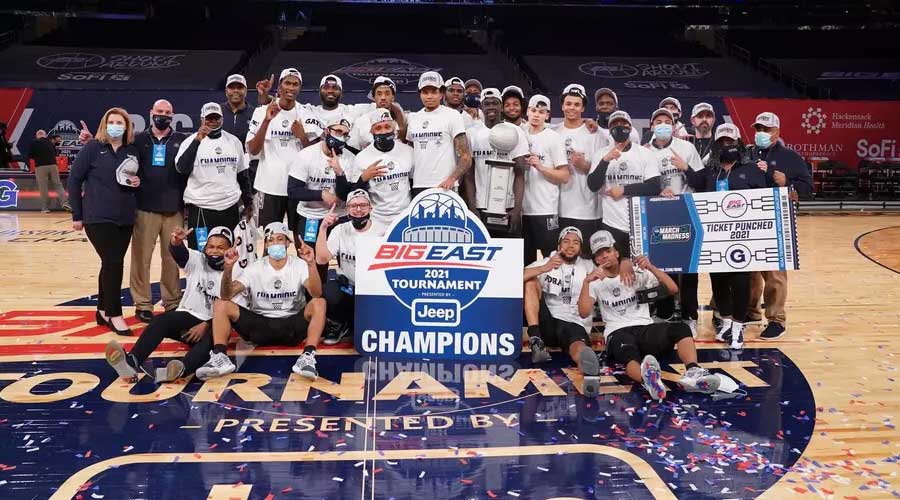
Three years removed from its 50th anniversary, the Big East Conference is rooted in the tradition of its men's basketball tournament. A total of 45 teams have hoisted a championship trophy, including 11 national champions and 25 Final Four teams. None of the 45 champions, however, were as utterly unlikely to have done so as the 2020-21 Georgetown Hoyas.
It is now five years removed for a team that won just nine regular season games and somehow managed to run the table for Georgetown's first Big East tournament championship in 14 years. The story of the 2020-21 season has, in no small part, became an outlier for a decade of discouragement; yet, it also serves as an example of another kind: the power of teamwork to overcome the most unlikely of obstacles ahead of them.
On March 11, 2020, Georgetown faced St. John's in the opening game of the Big East tournament before 17,534 at Madison Square Garden. Wednesday had become the beginning, and the end, for Georgetown's annual tournament ambitions. Since the reconstitution of the conference in 2014, the once mighty Georgetown program had a combined record of 1-5 in the tournament, with four losses on the opening night. Having lost five straight since Mac McClung was lost with a foot injury, the Hoyas limped into the opening round versus St. John's without much buzz. Despite holding a surprising 62-52 lead with 6:31 to play, the Redmen embarrassed the Hoyas with a 23-0 run to end the game, as Georgetown missed eight shots and gave up four turnovers in its final 12 possessions, with head coach Patrick Ewing opting to call only one timeout down the stretch--his worst game in three seasons as Georgetown's head coach, and clinching his first losing season.
The Hoyas' bitter loss wasn't the center of attention that evening, however.
The murmur about a respiratory virus seemingly confined to Italy and some nursing homes in Seattle became much more than a murmur that day. On March 11, the World Health Organization announced that the SARS-CoV2 coronavirus would be elevated to a pandemic, and the Dow Jones average dropped 1,200 points. President Donald Trump announced a 9:00 address to the nation.
In the moments following the Georgetown loss and prior to the second game that evening with Xavier and DePaul, cell phones across Madison Square Garden buzzed with a domino effect of unexpected and unsettling news: President Trump had announced a ban on all inbound flights from Europe to combat the virus. Actor Tom Hanks and his wife were reported as having been infected with the virus while shooting a film in Australia. The NBA's scheduled game between Utah and Oklahoma City was being held up.
"Shortly before tipoff, the referees and coaches conferred about an unsettling development: Jazz center Rudy Gobert's coronavirus test had just come back positive," read an NPR report. " A moment later, the public address announcer took to the microphone. "The game tonight has been postponed. You are all safe," he said. Cries of dismay rang out from the stands. "Take your time in leaving the arena tonight, and do so in an orderly fashion." In the interim, a second Jazz player was also found to be positive.
Minutes later, ESPN cameras caught the sight of Dallas Mavericks' owner Mark Cuban as he received a text message from league headquarters: the NBA wasn't merely postponing the Oklahoma City game, they were postponing the remainder of the season. "This is much bigger than just the NBA," he said.
Rapid announcements followed via text: the Big Ten Tournament was cancelled. The ACC, SEC, and Pac-12 quickly followed suit. The Big East and NCAA tournaments would be cancelled the following day. As Xavier and DePaul dutifully continued its first round game played before a visibly diminishing crowd in the Garden, the world was changing with each passing hour.
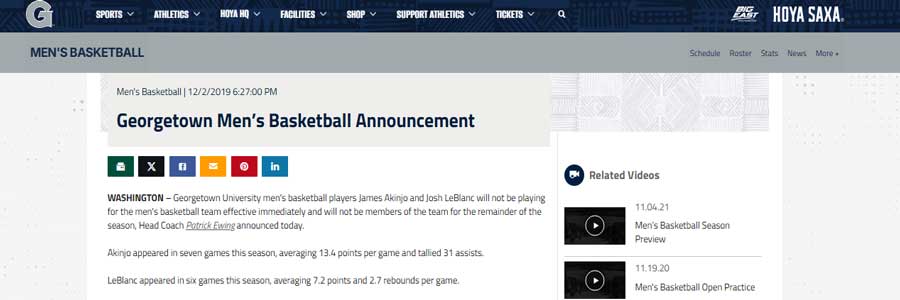
Georgetown's 75-62 loss to St. John's was the end of what was already a chaotic season for Ewing and the Hoyas. Seven games into the season, starting point guard James Akinjo quit the team; the news of his departure was unfortunately paired with an announcement that forward Josh LeBlanc had been dismissed from the team at the same time. Social media then posted legal documents which held that LeBlanc and two other players, Galen Alexander and Myron Gardner, were cited in a civil complaint by a Georgetown student alleging charges of burglary, threats of bodily harm, and sexual harassment going as far back as September 15. A temporary restraining order had been filed two weeks earlier.
The University, caught off guard, went through three round of press releases; first, to take Akinjo's name out of the legal conversation, and second, to take pressure off Ewing, who did not disclose what he knew about the complaint filed November 5 and, more importantly, when he knew about it. Further complicating matters: Alexander and Gardner remained on the team for the next two weeks before abruptly leaving in mid-December, which effectively ended any student judicial review hearing in the second semester that would have invited public testimony from Ewing and others.
"Please know that we are deeply committed to the integrity of our athletics program." wrote athletic director Lee Reed in a statement on December 3. "Coach Ewing has taken additional steps to ensure a culture of responsibility and integrity within our Men's Basketball Team."
"While I can't comment on individual students, please know that we take conduct issues very seriously and that our players are subject to the same disciplinary policies and procedures contained in the [University] Code of Conduct that apply to any undergraduate or graduate student," wrote Ewing a day later. "I expect the highest standard of conduct of my players and they are given no special treatment when it comes to their behavior and discipline. This is a fair and equitable process for all students...I won't have any more to say on these allegations at this point."
Within two weeks, Georgetown had lost four players. By the end of the regular season, the Hoyas suffered two mid-season injuries to McClung, an ankle injury to center Omer Yurtseven, and a broken leg to freshman center Malcolm Wilson in the final week of the regular season, leaving seven scholarship players and three walk-ons to finish out the season. It didn't make the bizarre finish to St. John's any less tolerable, but the setbacks soon paled in comparison to the world around them.
Following the St. John's loss, the team returned to find the campus was vacant. Classes were cancelled, faculty were moving to online learning, and students had two weeks to vacate their dorms and head home. Spring sports were summarily cancelled.
"Over the past two days, there have been significant developments in the global, national, and local responses to the ongoing spread of the virus," wrote Georgetown University president Jack DeGioia (C'79, G'95). "The actions we are taking at Georgetown seek to mitigate transmission of the virus--to slow 'community spread'--and to protect the most vulnerable from its worst impacts."
At this point, it was unclear what awaited the Hoyas in the fall of 2020, and who would be there. On March 14, Yurtseven declined a second year at GU and declared for the NBA Draft, despite it being postponed until November. Amidst rumors that McClung was unhappy with the care he was getting for his injuries, he announced March 29 he was following Yurtseven into the draft, though he ended up transferring to Oklahoma State after an Ewing interview with ESPN's Andy Katz where Ewing said McClung would not enter the draft and would instead be returning to Georgetown.
"I really wanted to stay, but things throughout my career [at Georgetown] made me realize that I couldn't," McClung said.
Ewing later told the Washington Post that "I spoke too soon" about McClung's plans.
At 49-46 through three seasons, "our future is still bright, in my opinion," Ewing said. "We still have a long way to go. We were doing extremely well the first year, did well the second year. Third year, it was a hiccup in terms of the four guys that left [and] kind of set us back from where I thought that we would have been. But it's all about improving and growing from that."
As Ewing adjusted to picking up more recruits to account for the attrition, he became a news story of his own: in May, he contracted COVID-19 and was eventually hospitalized. Though the severity of his illness was never disclosed, Ewing was seen some visible weight loss in a podcast interview held in June with Fox Sports' John Fanta.
“Don’t take it for granted. Practice social distancing. Wear your mask. Wash your hands.”
— John Fanta (@John_Fanta) June 25, 2020
Patrick Ewing opens up about his battle with coronavirus and shares his advice to everyone:
pic.twitter.com/CksdWbwXbA
On August 30, the family announced that Thompson had died.
"I was able to go over there the Friday before he passed," Ewing said. "We sat and talked and just laughed. I didn't know it was going to be goodbye because I was planning to go back. Then I got the text late on Sunday that he had passed."
John Thompson's cause of death was never disclosed; the family merely acknowledged what it called "multiple health challenges" to the press. At his funeral on September 9 at St. Augustine's Catholic Church in Washington, four men stood as pallbearers: Patrick Ewing, Alonzo Mourning, Dikembe Mutombo, and Allen Iverson.
The weight on Ewing's shoulders as the man carrying the Thompson legacy at Georgetown was evident. John Thompson was not only Ewing's greatest advocate for the past 40 years, but was cited as the man who cleared the tracks to allow the search committee to select Ewing, a candidate with no prior college coaching experience, as the only candidate for the Georgetown job following the firing of Thompson's son, John III. Once a candidate, now the coach, Ewing entered his fourth season without his long-time mentor and friend, amidst a season that was going to test him in ways great and small.
Amidst all the coverage of Thompson's death, there was a school year to begin and a team ready to compete. Uncertainty was everywhere.
By the fall of 2020 Georgetown University had, for all intents and purposes, been shuttered for the past six months. There had been no commencement, no reunion, no Kenner League. Hopes that the University would welcome as many as 2,000 students, including the entire freshman class, under social distancing rules were shelved late in July: only students with "special circumstances" would be allowed by the fall. These special circumstances were apparently applied to men's and women's basketball, the only two sports teams still in operation. Students situated on the campus would live alone, dine alone, be subject to medical tests twice weekly, and take all classes virtually.
"This past week, Mayor Bowser extended Washington, D.C.'s emergency declarations through October 9 and added new restrictions on travel into the District of Columbia-requiring quarantine for 14 days for travelers from designated "high risk areas," read an official University statement. "These new D.C. restrictions reflect a growing awareness and concern about the accelerating spread of the virus in the United States and the speed at which COVID-19 test results can be delivered. These developments indicate a strain on our public health framework. In addition... the District, Maryland, and Virginia are designated as "high risk areas" by states throughout the country."
Even amidst COVID, this was not the roster that the staff had envisioned. With just one graduate student and one senior entering the 2019-20 season (Terrell Allen, Jagan Mosely), Ewing and his staff expected a veteran lineup in 2020-21 and had signed only two recruits: Terrance Williams, a three star forward from Gonzaga HS in Washington, and Dante Harris, a two star recruit who grew up in Washington but had relocated to a suburb of Knoxville when his father relocated there to become an airline ramp agent. By the summer, just five scholarship players remained: one guard, one forward, and three centers.
Recruiting had been turned upside down. Williams decommitted soon after the LeBlanc issue was publicized, and another recruit, Tyler Beard, opted for prep school in January in lieu of joining the team that year. The Georgetown staff scrambled for any recruits it could land, signing five within a 40 day period after and eight overall.
Two graduate transfers would fill the open starting roles: Jalen Harris, a former point guard at Arkansas, and Chudier Bile, a little-known junior college forward with one year at Northwestern State (LA),. A third grad transfer would provide depth at guard: Donald Carey, a guard from Upper Marlboro MD who had played at Mount St. Mary's and Siena, graduating two years early.
Ewing had a team, now, did he have a schedule?
Entering the fall, it was unclear what the Big East, among other conferences, would do as to scheduling. Its media partners expected content, so canceling the season was not an option, but circumstances varied widely among the 10 schools. COVID restrictions were considerably looser in Nebraska (Creighton) and Indiana (Butler) than the east coast. A plan to play all conference games under a protective setup known as a "bubble" in Omaha did not gain traction. COVID was among its most severe within New York and the District of Columbia. By the end of September, 15,358 DC residents had tested positive and 628 had died, with thousands in mandated isolation.
From HoyaSaxa.com:
On October 28, the Big East held a virtual Media Day. For the first time in school history, Georgetown was picked last in the poll."The District of Columbia Mayor's Office has extended COVID-19 restrictions through Dec. 31, 2020, adding to the uncertainty for Georgetown to host men's and women's basketball games in 2020.
Phase 2, enacted June 22, closed a number of activities including the numerous private and public gatherings, including athletic activities. The decree signed October 7 repealed the earlier clause from June banning "high-contact sports", but maintains a limit of 50 persons in any private or public setting, including participants. Further, only a stated number of facilities may host such events, and neither Capital One Arena nor any athletic facility was on the original list. Athletic events across the District appear to be on hold in a mix of contingency plans. DC high schools do not expect to begin basketball until Jan. 4 per an earlier release. NBA and NHL games are not scheduled to return until the end of the calendar year, and none of the six universities within the District (Georgetown, George Washington, American, Howard, UDC, or Catholic) have announced any schedule plans. In fact, no major Division I school has finalized schedule dates.
October 19: "The District of Columbia has expanded its 14-day quarantine list to 39 states Monday, raising a question if Georgetown can meaningfully schedule home games this season. Eight more states were added Monday, including Connecticut (UConn), Ohio (Xavier), Pennsylvania (Villanova) and Rhode Island (PC). At this stage, the only Big East schools eligible to travel to Washington would be St. John's and Seton Hall. States without a quarantine restriction include Maryland, Virginia, New Jersey, New York, Maine, New Hampshire, Vermont, California, Oregon, Washington, and Hawaii."
"It is what it is, I mean we lost a lot of guys," Ewing said. "When you look at the amount of talent that we lost that should have been here, guys going into their junior year, guys going into their sophomore year, I would pick us last."
Georgetown entered November 2020 without a schedule, without a home facility, without a television schedule, and with no outlook on whether fans could attend the games.
The second wave of COVID was foretold as more widespread and more virulent than that seen in its earlier stage.
"Infections are soaring throughout the region," wrote the DCist web site in November. "The 3,219 cases reported on Friday in D.C., Maryland, and Virginia were the largest daily tally for the area since the 3,120 reported May 1, according to the Washington Post. Nationally, cases are skyrocketing, with a million new cases reported in just 10 days, the New York Times reports."
In a document entitled "Core Principles of Resocialization of Collegiate Basketball", the NCAA maintained a 14 day quarantine for any player testing positive--on November 12, Seton Hall became the first Big East school to announce a two week stoppage following COVID issues in its program.
Even with a small number of students on the Hilltop, Georgetown had already recorded 145 positive cases through November 15, though none reported for the men's or women's teams. By the end of November, Georgetown had finalized with the District a five game non-conference schedule, with four home games played in a closed environment at McDonough Gymnasium, with the only road teams coming from states not subject to a quarantine. Cardboard cutouts of fans placed in the bleachers were the only faces seen beyond coaches and players. Coats and ties for coaches gave way to athletic wear and face masks. There were no cheers, no music, only the sounds of shoes squeaking across the floor and the occasional official's whistle.
Ready or not, the 2020-21 season was underway.
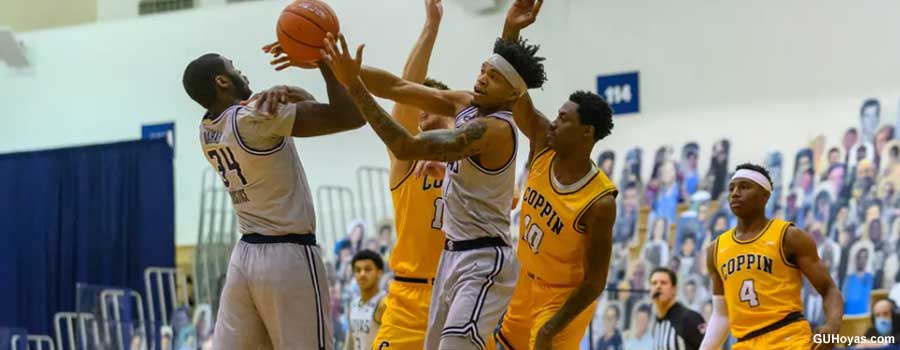
Georgetown opened the season with a pair of wins with UMBC and Coppin State as expected, a seven point loss to Navy, less so. The Hoyas seemed to tire late in games, as a 17-4 closing run by West Virginia earned it a nine point win. Up 18 over Villanova, the Hoyas scored just 17 points in the second half and lost 76-63.Three players - Jamorko Pickett, Jahvon Blair, and Chudier Bile-- accounted for 55 percent of the Hoyas points to date.
Ewing needed more from his guards, and an unexpected change allowed a freshman to become a leader.
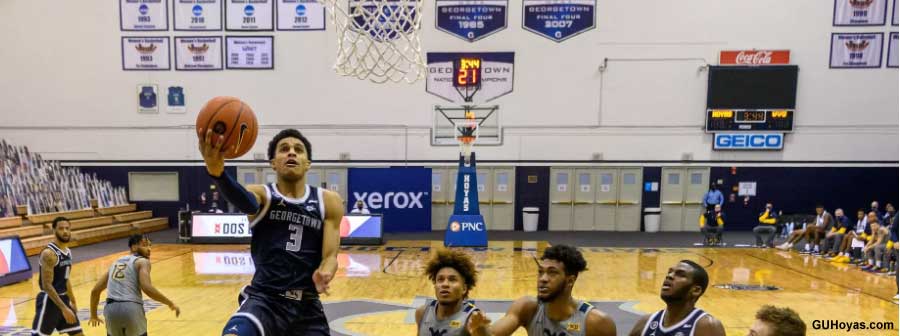
Through five games, graduate transfer Jalen Harris had started at point guard, averaging 5.2 assists per game. Harris (#3, above) was held out of Georgetown's 97-94 win at McDonough on December 13 versus St. John's for what was reported as back spasms; five days later on December 18, it was reported he was taking a leave of absence to deal with an undisclosed family issue. It was the last mention Georgetown University ever made about Jalen Harris, who never returned to the team and never played college basketball again, even with an extra year of college eligibility available to him. Five years later, he has never publicly commented about Georgetown.
In Jalen's absence, another Harris, though unrelated, stepped forward. Dante Harris was the least prominent recruit of the freshman class, but his elevation to the lineup was a turning point to the Hoyas' hopes in 2020-21. In his first start, he scored 22 points in the win over St. John's. Second on the team in assists and fifth in scoring by season's end, Dante Harris was an unusually strong foul shooter, missing only four attempts all season. This would become a factor in games down the stretch.
The 2020-21 team was simply poor on the road. Facing four road games in five games heading into January, Georgetown lost all four. It ended a game versus St. John's shooting one for nine, then opened three nights later against Seton Hall shooting 3 for 24 in a 78-67 loss. At Butler, it scored two field goals in the final 14 minutes of the game. Its lone home game in this stretch saw it score six points in the final nine minutes and lose to Marquette by four.
"From its 74-69 loss [at Syracuse] Saturday, Georgetown's 3-8 record is the worst start in any single season since the infamous 3-23 campaign in 1971-72, and only the second time in the last 88 years where the Hoyas have lost eight of its first 11 games to open a season," read a recap. "Its turnover rate continues unabated, with 12 against Syracuse and 174 in 11 games this season. Per ESPN, Georgetown is turning the ball over on an astounding 22 percent of its possessions this season."
Three road games in January threatened to sink the season. Soon, real life got in the way.
Positive COVID tests were causing havoc throughout the Big East. By early January, DePaul had postponed seven Big East games, while Villanova postponed or cancelled five games scheduled between January 2 and January 15. At one point, Xavier would lose seven of eight games mid-season. A pair of Georgetown home games with Connecticut (December 13) and Creighton (December 30) were rescheduled because of issues in those programs. On January 13, the basketball office announced a COVID-19 issue within the program and cancelled four games over the next two weeks, a home game with DePaul and road games at Providence, Marquette, and Xavier.
Entering the end of January, Georgetown had not practiced in two weeks. Its next game, a home meeting versus Providence, signaled a change for a team which was beginning to find its way.
Down 10-0 to start the game, Georgetown trailed by as many as 15 in the first half before rallying after halftime, holding the Friars to 37 percent. A total of 19 points off the bench by Chudier Bile led the Hoyas to a 73-72 win; five days later, he scored 17 as the Hoyas upset Creighton, 86-77.
Georgetown was becoming competitive with every team they faced. Even when falling short, such as a 84-74 loss to #3 Villanova, it was playing tough to the end.
That was a really tough Big East game against a Georgetown team that is playing really well," said Villanova coach Jay Wright.
Following a 63-48 loss to #19 Creighton, the Hoyas faced the softer side of its Big East schedule and took advantage. Taking four of five, the Hoyas finished over .500 in the month of February for the first and only season in Ewing's tenure--in the three seasons prior he was 7-13 in games held in February.
A split of games played in the first week of March (72-66 over Xavier, then a 98-82 loss at UConn) maintained the Hoyas as the #8 seed heading into a Big East tournament like none other.
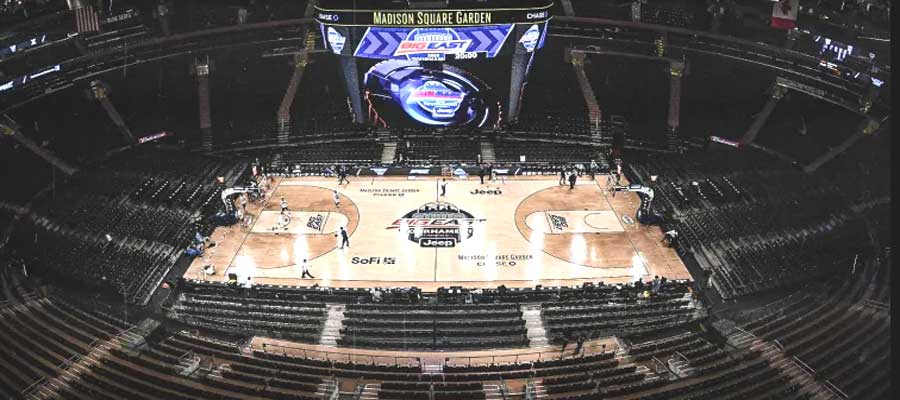
It was March 10, 2021, one day short of one year since the world began to change, and here I was, watching the first round of the Big East tournament on TV. This was unusual on many levels.
I am one of a group of classmates who, since college, have attended every Big East tournament since, whether or not Georgetown advanced in it. If there was a moment in the pre-game tournament highlight reel, I have seen it first hand--from Michael Graham's swing to Kemba Walker's step-back and everything in between. But like everyone else, I couldn't be there. The Big East played the 2021 tournament in a closed Madison Square Garden., A handful of tickets were offered each school for family and staff, but that was it--no cheerleaders, no bands, no scalpers on 7 Avenue, no Red Panda...and most importantly, no fans. It was a reflection of a world where COVID-19 was still a very real concern - by March 2021, New York State had confirmed 1.68 million cases and 39,021 deaths, 9,000 of these in the past two months alone.
Yes, I wished I was there. However, the conference could afford no such risk by adding fans--one positive test by a player or staff member could have grounded the entire tournament and cost the schools millions if its teams were unable to participate in the NCAA's.
So, like everyone else, I sat at home instead, about to watch the wildest four days in Georgetown basketball history.
As it did in 2020, Georgetown opened the tournament on a Wednesday night, this time against Marquette. The Hoyas weren't particularly strong to open the game but its defense completely overwhelmed a Marquette team which had won four of its last five and, with a good run that week, could have sought an NIT bid. By halftime, the Warriors had shot 21 percent, missed 11 of 13 from three point range, and were outrebounded 30 to 15, with the fewest first half points (14) in a Big East tournament game since 2002.
The teams played basically even for a second half in which Georgetown finished with 20 second chance points, a +14 on rebounds, and won by 19, 68-49, its biggest margin of victory in an opening Big East game in 11 years, behind 20 off the bench from Jahvon Blair and 19 from Qudus Wahab.
"Tonight it was a total team effort," said Ewing. "Everyone did something positive to help us win. Don Carey was solid. Jamorko Pickett, he didn't shoot the ball particularly well but did a great job defensively and getting opportunities when he had them. And the big fellow here, Qudus played great for us. He got tired in the second half.... [I] took him out and Timmy Ighoefe came in and [he] did a great job. It was a total team effort."
Georgetown advanced to Thursday's quarterfinal against #1-seed Villanova, which was where the 2020-21 season would have been expected to end. The Wildcats entered the game at 16-5, ranked as high as #3 nationally before a pair of late season road losses at Butler and at Providence. Villanova swept the series with Georgetown this year, the only team to have done so against the Hoyas, and was 16-2 versus Georgetown since 2013-14 season. In its last eight seasons, Villanova was 114-27 (.808) in conference play, with four Big East titles in the last five tournaments, (the fifth was an upset in the 2016 final by Seton Hall). Four members of the 2020-21 team would go on to the NBA.
One of these four, however, did not play. Senior guard Collin Gillespie, the co-Big East Player of the Year, tore his MCL eight days earlier versus Creighton and was out for the season. Replaced in the lineup by the offensively challenged Chris Arcidiacono (who had scored two points all season), the Hoyas answered with its biggest game in a decade.
From a 37-35 Villanova lead at intermission, the game recap told the story of an unlikely second half:
For its part at the line, Villanova finished 14 of 22."Villanova went back inside and pulled ahead, hitting seven of its first 10 shots of the half and building a 52-46 lead. ...with 8:52 to play, a Justin Moore three put Villanova up 11, 61-50. But just as they had done to end the first half, the Cats went cold down the stretch, and Georgetown methodically clawed its way back. [Leading 61-57, a] fifth foul from Chudier Bile sent Robinson-Earl to the foul line at the 7:17 mark, but he missed one of two. Free throws from Qudus Wahab closed to 62-57. Off a Robinson-Earl travel, The Hoyas went big from outside, connecting on consecutive threes from Harris and Blair to retake the lead, 63-62, a 13-2 run.
Dante Harris, playing the best game of the season, hit two free throws to close to 70-67, whereupon Samuels missed a jumper with 57 seconds remaining, and the Cats were decidedly out of position when Blair found Wahab down low, as Cole Swider picked up the foul and Wahab picked up a three point play with :40 to play, 70-70. Wahab picked up his fifth foul 22 seconds later, fouling Robinson-Earl with 0:18 left. With the game on the line, Robinson-Earl split the free throws once again, giving Georgetown a chance to hold for the last shot. Instead of hanging outside, Harris drove inside and was fouled.
It was at this point that the Fox Sports 1 announcers noted a little bit of history: Harris stood at the line after Georgetown had made all of its 21 free throws of the game. The freshman watched the first one roll around and in, and looked skyward in a moment of thanks. Harris calmly connected on the second, 72-71, and without a time out remaining, the Wildcats settled for as 20 foot shot that went stage right. Georgetown finished a school record (and tournament record) 23-23 from the foul line, and needed every one of them tonight."
"We just played together and kept fighting," Harris said in post-game quotes. "I told my guys to never give up, and we just continue to play together."
A third opponent awaited Georgetown the next evening in #5-seed Seton Hall. The Pirates had stumbled to end the season, dropping four straight before upsetting St. John's in the quarterfinal. Seton Hall center Sandro Mamukelashvili, had 13 games of 20 or more points this season, and was coming off a 20 point, 11 rebound effort versus St. John's.
Defying the odds once again, the Hoyas advanced. "A 9-1 run to close the game propelled the Georgetown Hoyas to its first Big East finals in 11 years, steering past Seton Hall 66-58 and await a rematch with #2-seed Creighton on Saturday," read the game recap. "A Qudus Wahab block and three Dante Harris free throws were the difference, turning a 57-57 tie with 1:59 to play into a commanding win and Georgetown's first trip to the Big East finals in 11 years.
"The game was 40 minutes of what has become a remarkably reliable playbook for Ewing: get a quick start, make fewer turnovers, escalate defensive pressure inside, and wait for the opponent to fold late," read the game recap. "It was run like clockwork Friday evening, as a Seton Hall team playing for their NCAA lives were their own worst enemy and never dictated the flow of the game."
"In the last 40 days, [Dante] Harris has made 20 of his last 22 attempts from the line. With three on the line to put it away again, he delivered. A pair of late free throws by Pickett closed the scoring. And if you're wondering what has changed with this Georgetown team, consider this: its last turnover in the Villanova game was with 9:50 to play. Its last turnover in this game was with 7:20 to play. Simply put, Georgetown is putting itself in a position to win, not to come back. The Hoyas trailed for just 1:11 in this game. The Hoyas may not be a great comeback team, but when you lead, of course, you don't have to come back."
As for Mamukelashvili, he started the game 1 for 12 and finished with eight points. Were he to have done anything close to his seasons average, the Hoyas were taking their bows that evening with its best tournament showing in eight years. Instead, they returned Saturday night to do what only seven Big East schools have ever done: four games in four days.
If the Hoyas hadn't caught a break with Gillespie's absence, or Mamukelashvili's shooting, they caught a third break entering the final.
UConn had dominated Georgetown in its two regular season meetings, but Georgetown had fared better against Creighton, earning a split. In a closely fought semifinal, Creighton steered past Connecticut 59-56, for its third finals appearance in seven years.. If the Hoyas could dial up the defense, they had a fighting chance, and this is exactly what they did.
Georgetown's 73-48 win over Creighton was stunning in its depth and breadth. From an 18-18 tie with 5:52 in the first half, , the Hoyas held the second seeded Bluejays scoreless in an 18-0 run over the final 5:52 of the first half and an astounding 1 for 16 over the final 8:39. Creighton guard Marcus Zegarowski was 4 for 5 and finished the half with nine points. The rest of the team shot 4 for 25 and also finished with nine points.
Per the game recap, "Zegarowski opened the second half with a basket, 36-20... but Creighton did not get a second field goal in the half until the 13:52 mark, now 54-26, and could not stop the Hoyas to make any sort of run. A Creighton turnover was buried by a Blair three, 57-28, and back to back baskets inside, 63-34, at the 9:02 mark. Time was running out on the Bluejays."
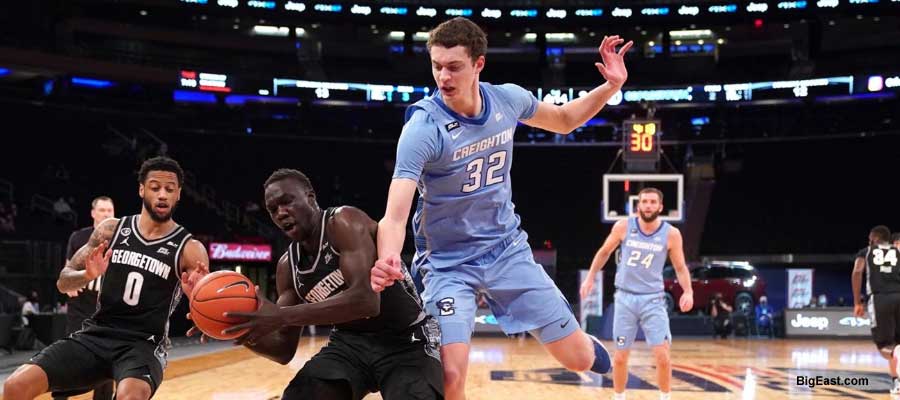
Bile led all scorers with 19 points, followed by 18 from Blair, 11 from Wahab and 10 from Harris. Per the recap, Blair averaged 15.1 points over the four games and according to the Elias Sports Bureau scored the most points off the bench during the tournament (61) than anyone in conference history."
"But it was Harris' body of work -- offensively, defensively, and the free throw line (a combined 10 for 10 over four nights) that earned him the Dave Gavitt Award as the tournament's most valuable player. Harris, once ranked just #415th nationally by one recruiting service, became the first freshman to win Big East MVP in 23 years. Creighton finished shooting 28 percent from the field, 26 percent from three, and missed seven of 12 at the free throw line. They were outrebounded 49-33 and were beaten badly on second chance points: 17 to 1."
Four Georgetown players finished in double figures but it was Ewing who was the toast of the town. He took ample opportunity of reminding people that he was worthy of the accolades.
"As a coach, I'm here where a lot of people didn't think that I had the ability, and I'm proving everyone wrong," he said.
"Obviously for Georgetown this is deeply personal," commissioner Val Ackerman told the Washington Post. "I think for Patrick and for the program to take the step this year and to prove I think to everybody that Coach Thompson's legacy is alive and well, and now the torch has been handed off to his protege, and in a way things are coming full circle."
Georgetown received the autobid to the 2021 NCAA tournament, which had been realigned to six sites, all without an hour of Indianapolis, which became a secure place for all teams to stay. The 12th seeded Hoyas would play #5-seed Colorado (22-8) at Butler University.
"Colorado is the next step that we have to take," Ewing told ESPN's Mike Greenberg in advance of Georgetown's first round game. "We don't know a lot about them right now, we we've started watching film on them last night, and we're going to continue to watch the film [and] come up with a game plan. But I do believe that if we continue to play the way that we shown that we can play in New York, we should be fine."
"There's been a lot of people in [the media that] said that I shouldn't have gotten the job here at Georgetown and I'm shutting all of them up."
If this was Patrick Ewing's victory lap, it was a brief one. Georgetown was the opening first round game on CBS and the first to go out. The Buffaloes did their homework on the Hoyas' perimeter defense and ran away with this one by halftime, setting an NCAA record with 11 three pointers by halftime.
Colorado led by 23 at the break and 23 at the end, 96-73, with its last points of the game being a three pointer with 0:35 to play. For the game, Colorado shot 60 percent from the field and 64 percent from three: 16 for 25. The Georgetown defense which had held its four Big East tournament foes to 56 points a game had given up 56 to Colorado less than four minutes into the second half. Freshman Jabari Walker, coming off the bench, was 9 for 10 from the field and 5 for 5 from three point range.
Ewing didn't have much to add after the game. "Overall I'm very proud of our guys," he said. " Naturally I'm disappointed in the outcome, I'm disappointed that we didn't play our best game, but I also have to take my hat off to Colorado. They played an outstanding game."
Any discouragement for Ewing over Georgetown's uninspired performance would be short lived. While it was only March for Georgetown, Christmas came early for Patrick Ewing.
Following the tournament, Ewing accepted a contract extension through the 2026-27 season, which eventually totaled over $12 million in compensation, benefits, and performance bonuses. Georgetown never issued a news release, and never offered a comment when it was disclosed by reporter Jon Rothstein eight months later.
Yet, it was not altogether unexpected.
Each of Ewing's four predecessors received their first contract extension on or about the fourth year of their respective contracts. Jack Magee was extended after his fourth season following Georgetown's NIT appearance in 1970. John Thompson was extended in either the third or fourth year of his original contract. By his fourth full season, Craig Esherick's contract was extended six seasons in 2003, but was released one year later. Before the start of his fourth season, John Thompson III was extended for six years in 2007 and renewed for six more years in 2013, and fired with would have been two years remaining on the second extension.
Esherick's extension, in the midst of rising public chatter about his cumulative record (90-59) and one NCAA appearance in his first four full seasons, was announced so as to quell public dissatisfaction. Thompson III's extension was anything but damage control--the Hoyas were coming off a Final Four.
Whether the Ewing extension was an option embedded in the original agreement or a timely renewal following the NCAA's is unlikely to be revealed, as are the motivations of the University in seeing the need to extend Ewing despite a cumulative record of 62-59. Perhaps DeGioia saw 2021 as having turned the corner. Perhaps he was unwilling to open Georgetown up to gossip that its greatest living athlete was not going to be retained following an NCAA tournament bid, or risk terminating a 30 year relationship with a personal friend, a former member of Georgetown's Board of Directors, and a potential donor with a total net worth exceeding $75 million. Perhaps, with the memory of John Thompson's death still fresh, cutting loose Thompson's hand-picked choice was uncomfortable. Or perhaps, in the midst of a whirlwind year on and off the court, it was simply easier to maintain that most comfortable of phrases within the Georgetown basketball office; namely, the status quo.
Had the Hoyas not won the Big East that year, would Ewing still have been renewed? Probably.
Ewing's extension was bound Georgetown to a sizable financial commitment in the midst of an uncertain road ahead. The University had lost tens of millions in tuition, room, and board during COVID, not to mention a season without any basketball ticket revenue. The expectation upon Ewing and his staff had been raised.
Still, there were early signs of trouble. Its top four scorers were all leaving: starting center Qudus Wahab, announced a transfer a week after the season's end to Maryland. Although the NCAA extended eligibility for all 2020-21 athletes, Chudier Bile, Jahvon Blair, and Jamorko Pickett-- each opted not to return for 2021-22. Two transfers were promptly added, though only Kaiden Rice made it to the roster, as Eastern Kentucky transfer Marvin (Tre) King was expelled prior to the start of the season.
— Tre King (@AtgTreking) October 16, 2021
The season opener was scheduled with Dartmouth, which didn't even field a team in 2020-21 due to COVID and whose last winning season was in 1999. The Hoyas' return to Capital One Arena was promoted with free admission for all guests, and 8,641 turned out--the largest opening attendance since Ewing's debut on November 12, 2017.
The results were demoralizing.
"Sixteen three pointers shredded the Georgetown Hoyas in a humbling 69-60 loss against Dartmouth at Capital One Arena Saturday," read the game recap. "The win was the first win for Dartmouth over any major college opponent since 1989, and the first regular season loss by Georgetown to an Ivy League opponent since a 1981 game versus Pennsylvania."
Despite erasing a 22 point first half deficit midway in the second, the Hoyas scored two field goals for the next eight minutes and never contended thereafter. Brendan Barry, grandson of former Georgetown All-American Jim Barry, sank six three pointers en route to 19 points on the afternoon.
"As we go along, hopefully we look back at this game and say this is the launching point of our season," said Ewing. " When I talked to people before the season started, I said it's going to be peaks and there's going to be valleys. Right now is a valley."
Patrick Ewing and the Hoyas never vacated the valley, losing an astounding 50 of 63 games over two seasons, including 29 consecutive in Big East play.
One March 9, 2023, Ewing was fired after a 84-48 loss to Villanova in the Big East tournament, a mere three weeks before his original six year contract was to have expired. Were there no extension, Ewing would have walked away without severance. Instead, as released in a 2025 IRS disclosure, Ewing exited with a severance of $12,549,824.
When asked about the buyout, a University spokesman offered this comment to The HOYA which read, in part, "Employment contracts are confidential and we are not able to comment beyond what is required to be reported by federal law...Patrick Ewing has dedicated his life to Georgetown basketball and his impact on the entire Georgetown community is immeasurable."
Owing to COVID-19, there was no public celebration for the 2020-21 team, and none followed. There is no banner of their collective achievement above Capital One Arena. Five years later, there is little public recognition of the team and its accomplishments.
Georgetown has won the Big East tournament eight times, a number matched only by one other school (Connecticut). Each of the seven prior titles were the prelude to significant NCAA post-season success, with four Final Fours and three regional finals awaiting these seven teams. The 2020-21 team was out in the first round.
Each of the seven prior champions carried numerous future NBA players on its roster: three in 1980, four in 1982, 1987 and 1989, and five each in 1984, 1985, and 2007. The 2021 team had only one NBA product, a free agent in Jamorko Pickett, who played in 13 NBA games over one season, and none since.
Six of the seven prior champions were led by that season's Big East Player of the Year, a list of some of the very best to have ever worn the Georgetown uniform: John Duren, Patrick Ewing, Reggie Williams, Charles Smith, Jeff Green. No Georgetown player made any all-conference team in 2020-21.
To some, the 2020-21 season was a fluke, an outlier, an asterisk, four days of good luck amid six years of steady decline. To others, the ill will of the Ewing era has taken the recognition of the 2020-21 season down with it, and fan support has reflected this outlook. In the last 75 home games at Capital One Arena since the 2021 championship, Georgetown has averaged 5,899 per game.
But the 2020-21 season was no asterisk.
Georgetown led the Big East in three point shooting in 2020-21, led the conference in rebounding, and was second in free throw shooting and offensive rebound percentage. At the conclusion of the 2020-21 season Jahvon Blair was sixth in the Big East in scoring, second in three pointers, third in free throws, and second in total minutes played despite coming off the bench for much of the season. Dante Harris led the Big East in free throw shooting with an 88.9% mark, Blair was third at 84.7%.
Jamorko Pickett and Jahvon Blair did what few players would today: they stayed four seasons. Together, they scored 2,244 points and are separated by just four points between them. They are one of 11 pairs of players from the same class to score over 1,000 points in Georgetown history, and the only duo to do so over the past 15 seasons.
One doesn't win a championship on luck, but with teamwork and commitment, even when things are tough. From a 3-8 start and the loss of its starting point guard at mid-season, Georgetown won 10 of its final 14 to make the NCAA tournament, with two losses to nationally ranked teams in Villanova and Creighton, each of which they defeated in the conference tournament. They earned this title.
If there is really no one reason why the 2020-21 champions aren't as fondly remembered as some other title teams, perhaps one more intangible comes to mind: they're not around anymore. Just four of the 13 scholarship players were from the local area and each is playing pro basketball elsewhere. Eight of the 13 transferred, with no connection to the team they left behind. For a Jamari Sibley or a T.J. Berger, a year in COVID-19 confinement does not form any lifetime bond to Georgetown University. For a Dante Harris, still playing at his fourth college in six years, even less so.
Finally, there's the coach. Patrick Ewing has not returned to Georgetown since his dismissal and it may be many years before he does. He is a proud man, and knows this didn't end well. In these pages, we wrote, "Thus was the Patrick Ewing paradox: the school's most prominent former player and the heir of the John Thompson dynasty ended his career, and the dynasty itself, holding the school's worst career coaching record."
But for one season, and for one remarkable week, Ewing could rightly quote the Drake song that summed up the 2020-21 campaign: "Started from the bottom, now we're here."